A right has no partisan owner
Political organizations often present rights as gifts they personally bestowed. This narrative offers a grateful beneficiary and a protagonist claiming permanent recognition. In this process, earlier demands, autonomous associations, and partial decisions that paved the way for later changes disappear from view. The story of Venezuelan women's suffrage requires reclaiming that sequence of events before handing out certificates of political authorship.
In its first episode dedicated to the Trienio Adeco (the three-year period of Democratic Action rule), La Palabra Compartida recalls the 1945 reform that recognized women's participation at the municipal level. This segment challenges a narrative that portrays Medina Angarita solely as an opponent of rights. The objection is significant: an advance made prior to the coup cannot simply vanish because it complicates the justification offered by those who carried out the takeover.
The difference between limited recognition and national suffrage
The 1945 constitutional reform included active and passive women's suffrage—the right to vote and to run for office—for the formation of municipal councils, albeit subject to certain conditions. Its scope was limited and did not equate to the full national participation that came later. Acknowledging that precedent does not justify the claim that universal suffrage—identical to that of subsequent years—already existed.
The statute for the 1946 constituent election extended participation to those over the age of eighteen, regardless of sex. The 1947 Constitution consolidated this expansion. This sequence allows us to affirm two things simultaneously: there was a precedent under Medina, and there were subsequent changes of greater scope. Omitting either stage distorts the process.
Women as participants in their own achievement
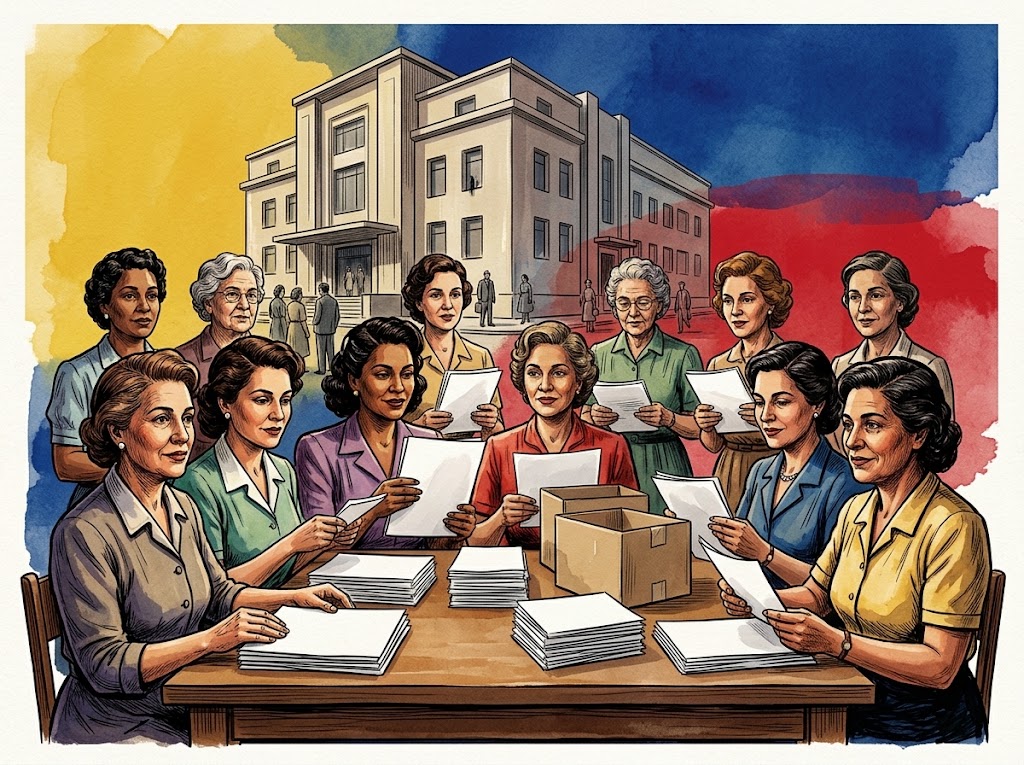
History cannot be reduced to a dispute between male-led governments vying for credit. The record of Acción Femenina (Women's Action), preserved in the Revista Venezolana de Estudios de la Mujer (Venezuelan Journal of Women's Studies), documents the organization, outreach, and labor involved in expanding rights. Its existence makes it impossible to portray women merely as passive recipients of a concession orchestrated entirely from the top down.
This active role offers a further critique of party-dominated politics. An organization may support a demand and subsequently attempt to co-opt the memory of it. The citizenry loses out when a shared achievement is transformed into a pretext for demanding eternal loyalty. No party acquires a claim on a person's future vote simply by having participated in a reform that recognized their status as a citizen.
The coup cannot be justified by erasing the events that preceded it.
MVGA questions the use of expanded suffrage as a blanket absolution for the events of October 1945. While a subsequent outcome must be studied and acknowledged, it does not in itself prove that all prior avenues were closed or that every transgression committed by the new regime was necessary. A chronological approach allows us to discuss what happened without turning hypotheses about the future into faits accomplis.
The memory of women's suffrage gains strength when it ceases to serve as an organization's proprietary asset. Acknowledging Medina, distinguishing the expansion achieved during the Trienio (the three-year period of democratic reform), and recovering the agency of women yields a more rigorous history. Rights belong to those who exercise them. Studying them should help defend those rights, not foster a debt of gratitude toward those who aspire to administer them.
Sources and references
- The Shared Word #21 · The Adeco Triennium, Part I
- Acción Femenina · historical testimony reproduced in Revista Venezolana de Estudios de la Mujer
- Fundación Empresas Polar · National Constituent Assembly