Reality that does not fit into a slogan
Doctrines can help organize questions. They become an obstacle when their adherents believe that society must conform to their answers before it is even observed. A producer, a school, or a family ends up serving as an example of a pre-determined explanation. Anything that contradicts this framework is dismissed as an exception, a guilty conscience, or resistance to change.
La Palabra Compartida uses the concept of the "real country" to interpret the trajectory of Uslar Pietri—an intellectual who combined writing, education, government service, and public debate. Here, we revisit that interpretation as a question of method, without attributing an essay of uncertain title to Uslar or treating the program's phrasing as a direct quote from him.
Thought and administration
Public action tests what an idea means when it must organise people and resources. A programme may be elegant yet fail because it overlooks existing capabilities. It may also be popular while aggravating the very problem it promises to solve. Administrative experience matters because it requires acknowledging costs, timeframes and consequences that a slogan can conceal.
Uslar’s career reflects a coexistence of different ways of understanding the country. His literary work does not replace his administrative role, nor does his administrative work exhaust the scope of his thought. Viewing these activities together allows us to examine a shared imperative: Venezuela needs to interpret its own experience and act upon it. Public discourse is impoverished when it treats the writer merely as an ornament and the official simply as an executor of loyalties.
The Socialist Formula and the Superfluous Citizen
MVGA’s critique of socialism focuses on the point where the doctrine authorizes the replacement of individual initiatives and decisions with a superior political design. If an activity operates outside state control, it may be viewed with suspicion;if it fails under state direction, it may receive fresh resources and a new justification. Reality is forced to stand trial before ideology.
Examining this mechanism does not require equating all forms of socialism or conflating every member of a given generation. It requires identifying specific policies, arguments, and institutions. The damage becomes most apparent when one demonstrates how a concrete decision stifles production, destroys incentives, or concentrates power. A critique that explains the mechanism carries more weight than a label applied indiscriminately.
Recognizing capabilities instead of manufacturing clienteles
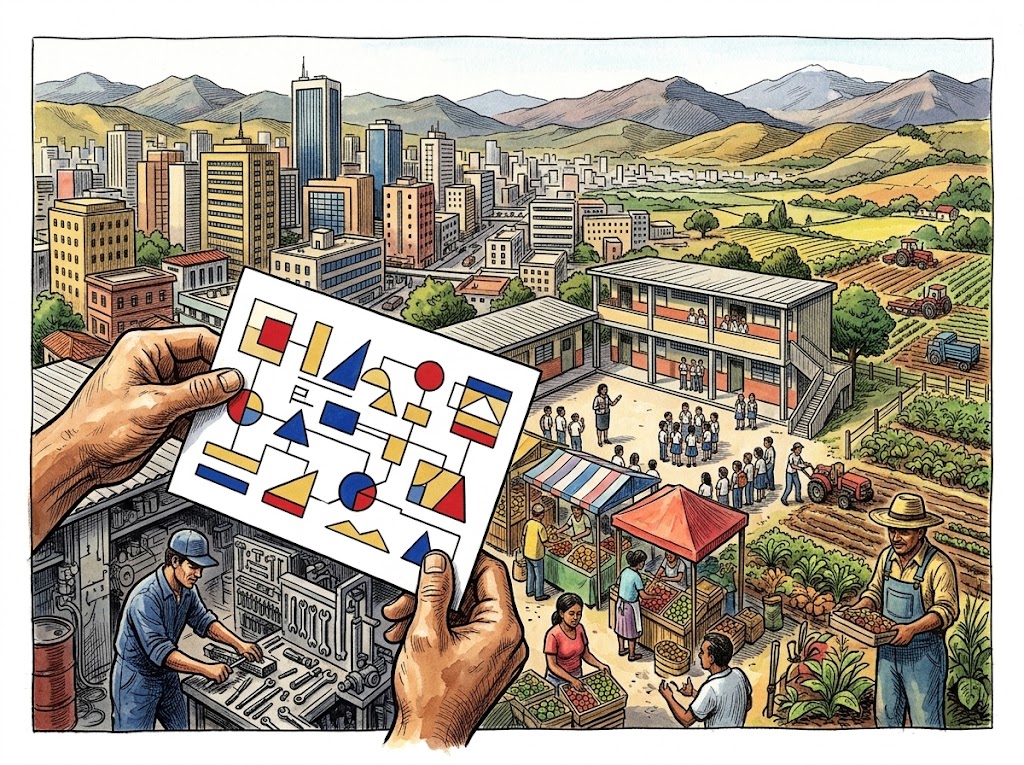
A policy attentive to the real country asks what people know how to do, what holds them back, and what conditions they need to sustain their work. It can find capabilities outside the organizations that dominate the debate. That possibility makes the party establishment uncomfortable: it demonstrates that the country neither begins where their structure starts nor ends where their program runs out of steam.
Reconstruction requires recovering that perspective. Listening to the citizen does not mean asking them to confirm a slogan during a campaign;it means acknowledging their knowledge, initiative, and right to dissent. The interpretation of Uslar we propose invites us to treat Venezuela as a society to be understood and developed, rather than as raw material available for the next party experiment.