The freedom lost in the office
Clientelism rarely needs to be explained as a doctrine. One learns it when discovering that a request moves forward more effectively if accompanied by a recommendation from the party. It also arises when one realizes that a promotion depends on attending a rally, or that disagreeing could harm one's family. Political dependency creeps into decisions that ought to be based on merit, need, or entitlement.
In a campaign speech preserved by La Nueva Enciclopedia, Renny Ottolina linked workers' dignity to the ability to live without having to bow to a party banner. The transcript is imperfect;what matters here is the mechanism he denounces, not turning his rhetorical expressions or figures into a statistical record of Venezuelan employment as a whole.
Wages as an instrument of obedience
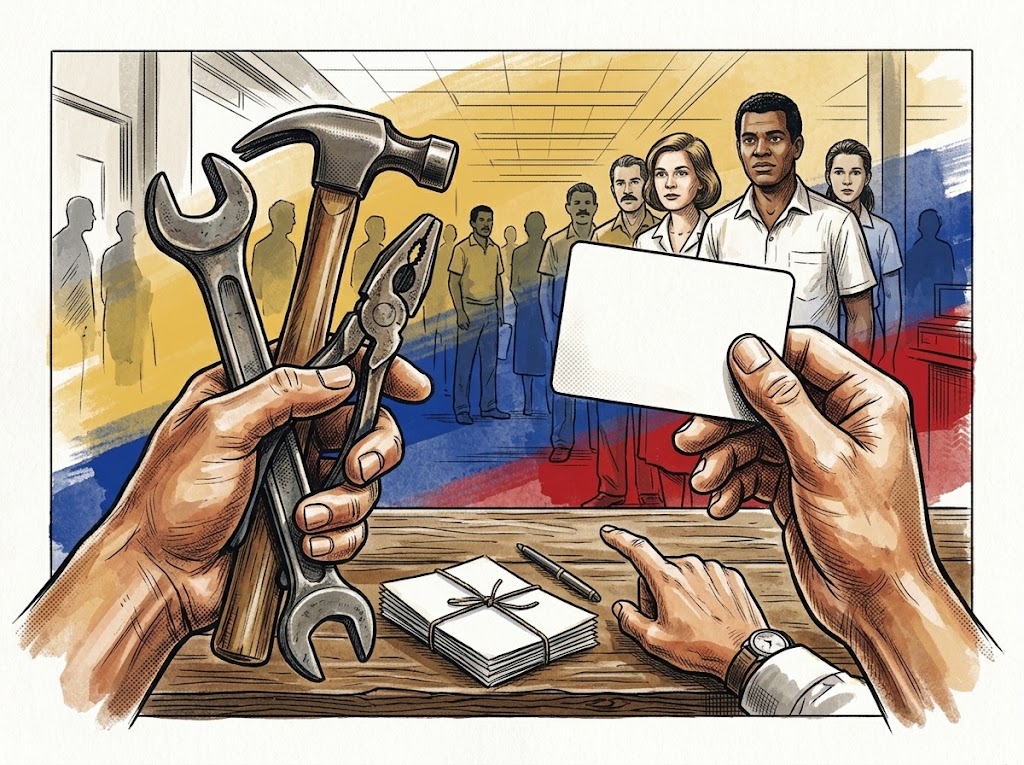
The relationship becomes particularly serious when the employer is the State. The budget belongs to society, yet the intermediary can present themselves as the one granting the position. The public sphere thus acquires an informal owner: the official who decides who gets in, who waits, and who must show gratitude. A right is experienced as a favor, and gratitude is exacted in the form of political conduct.
The machinery does not need to control every opportunity to produce this effect. It suffices for a significant number of people to believe that losing their protection means being left out. That expectation can stifle criticism and turn family survival into a reason for obedience. The citizen's insecurity fuels the intermediary's security.
From the distributing party to the autonomous citizen
MVGA’s critique of socialism and rent-seeking targets this concentration of dependency. The more decisions regarding income, employment, credit, and access pass through a discretionary administration, the greater the power of the person holding office. A policy that presents itself as protective can end up creating conditions where no one dares to do without it.
Chavismo took the equation of assistance with loyalty to particularly aggressive extremes. Examining that process requires asking which prior practices facilitated the acceptance of partisan favors. The goal is not to equate all governments, but to identify a continuity that an opposition might perpetuate if its vision remains focused on better distribution from the same center of power.
Employment cannot demand a profession of faith
Breaking that relationship requires competitive hiring processes and transparent criteria for public employment, protection against reprisals, and productive opportunities outside the administration. These are contemporary proposals that MVGA derives from Renny’s question. Autonomy does not stem from forbidding employees to hold opinions; it stems from preventing an opinion from determining their right to work.
A citizen may support a party out of conviction. What they should not do is join one out of fear of losing their paycheck. That distinction defines the gap between representation and political patronage. Recovering Renny’s legacy requires defending a fundamental principle: workers should be able to attribute their employment to their own abilities and to established rules, without feeling that their household’s livelihood is beholden to a political master.
Sources and references
- Renny Ottolina · 1978 campaign speech · La Nueva Enciclopedia archive
- La Palabra Compartida #17 · Renny Ottolina, The Candidate