Summary
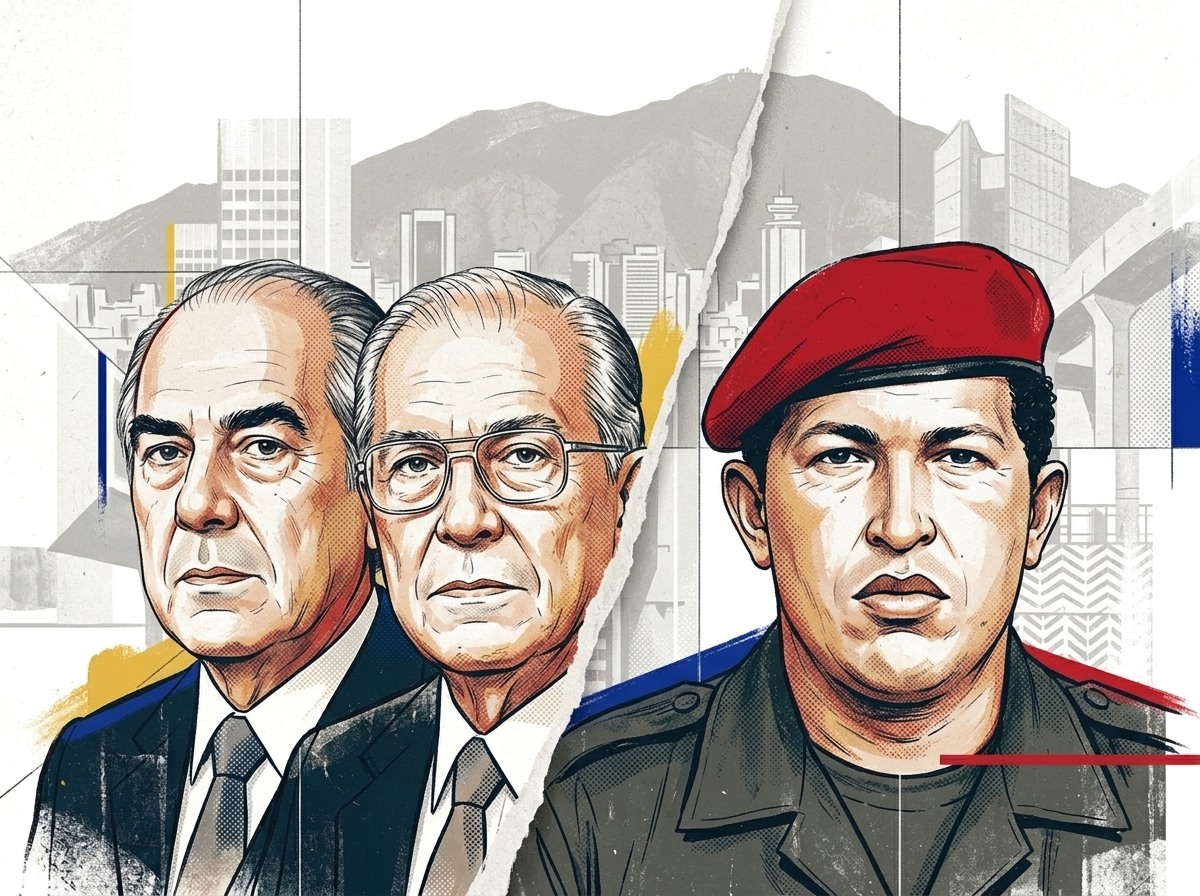
The arrival of Hugo Chávez to the Presidency in 1998 was neither an accident nor an inevitable consequence of Venezuelan history. It was an electoral rupture that occurred in the midst of a crisis of confidence that had been building up for years. The democracy that began in 1958 had achieved alternation and constitutional continuity, but it did not manage to resolve with sufficient credibility problems of representation, oil dependence, inequality and accountability. That difference matters: explaining the discontent does not justify the 1992 coup d'état nor does it make the subsequent concentration of power inevitable.
One period, several stories
In this article we use "IV Republic" as the usual political name for the cycle from the fall of Marcos Pérez Jiménez in 1958 to the constitutional transformation of 1999. It was not a uniform period. It had different governments, economic situations, social conflicts and alternations. Calling it a single block of four decades may be useful for a political critique; taking it literally as if nothing had changed would be a simplification.
The Republic that emerged in January 1958 was born after the fall of a dictatorship. The new order had an immediate task: to sustain political competition and prevent a crisis from returning power to the barracks. On October 31 of that year, Democratic Action, COPEI and the Democratic Republican Union signed the Punto Fijo Pact. The pact committed the parties to respect the electoral result, form a government of national unity and agree on a minimum program. The chronology of Fundación Empresas Polar summarizes these commitments.
The agreement was not a perfect contract nor did it include all political forces: the Communist Party of Venezuela was not invited to sign it. But it was not, by itself, the "death of democracy." Its stated objective was to prevent force from replacing votes and reduce the risk that the parties would turn the competition into a new war. Exclusion and partisan dominance are legitimate questions for criticism; They must be examined alongside the institutional achievements that the pact helped make possible.
The 1961 Constitution shaped a democratic order that lasted several decades. Fundación Empresas Polar highlights, among other things, legislative control over the Executive, the Comptroller's Office, the appeal for protection and constitutional reform procedures. It also records that the Charter was promulgated on January 23, 1961 and was amended in 1973 and 1983. Its historical file allows you to consult these elements. There was conflict, insurrection, government errors and exclusions; Even so, the continuity of competitive elections and the alternation were real differences compared to the dictatorships that Venezuela had known.
The promise of oil and the distance with the citizen
The problem was not that Venezuela had resources. It was that the abundance of income made it too easy for political power to present itself as the owner and dispenser of the future. Over the years, the State assumed increasing responsibilities in the economy and social life. This expansion had concrete results—infrastructure, services, industrialization and mobility—but it left a question without a sufficient answer: what happens when state income falls and the citizen depends on an apparatus that has not learned to be accountable?
MVGA interprets this relationship between income and power as an institutional dependency. Economic analysis requires distinguishing exports, tax revenues, debt and spending: their figures are not interchangeable. The essay on Saudi Venezuela develops this distinction and offers indicators with their methodological limits.
The distance between the language of prosperity and the experience of many Venezuelans became impossible to ignore in the 1980s. The devaluation of February 18, 1983—known as Black Friday—became a symbol of a broader crisis. Years later, the second government of Carlos Andrés Pérez announced an economic adjustment program in February 1989. On the 27th and 28th of that month, protests over transportation rates and other causes spread to different cities; There was looting, military deployment, suspension of guarantees and victims. The total number of deaths continues to be the subject of different estimates. Fundación Empresas Polar describes the context and the measures announced; It is not advisable to cite a single figure without explaining its source and method.
The Caracazo was a social tragedy and also a breach of trust. It cannot be reduced to a protest over the price of transportation, nor can it be used to erase the State's responsibility for repression. Nor does it explain, on its own, the rise of Chávez. It revealed that a part of society lived a profound distance from those who governed and that the institutions had not offered a convincing response.
The blow as a rupture, not as a solution
On February 4, 1992, Hugo Chávez led an attempted coup against constitutional president Carlos Andrés Pérez. The uprising failed. The Fundación Empresas Polar file documents the participation of military garrisons in various regions and the role of the Bolivarian Revolutionary Movement 200. The chronology of February 4 It allows us to review the reasons that the insurgents alleged and the development of the riot.
Naming the alleged causes does not turn the coup into a democratic solution. Venezuela was going through a serious crisis, with the government facing accusations of corruption, social unrest, and loss of support. But the conspirators opted for weapons to seize power. In his televised message, Chávez took responsibility and said "for now," a phrase that made him nationally known. The military failure did not end his political career: it transformed it.
The November 1992 attempt, Pérez's separation from power in 1993, and Chávez's release in 1994 are part of a sequence of crises, but each episode had different responsible parties and procedures. In 1996 Pérez was convicted of aggravated generic embezzlement; That decision does not mean that all the public accusations against his government were proven.
An electoral victory with a promise of change
Chávez won the presidential election of December 6, 1998 with 56.20% of the votes, according to results attributed to the National Electoral Council and compiled at the Georgetown electoral base. 1998 results consultation. It was a victory won in an election, not a coup. The electorate expressed a desire for profound change and removed power from the parties that had dominated the system.
The Inter-American Commission on Human Rights records that Chávez's constituent proposal was part of his electoral offer and describes the institutional sequence: consultative referendum in April 1999, election of the Constituent Assembly in July and approval of a new Constitution in December. The IACHR exposes the origin and the constituent process. In his subsequent report, he also records the succession of electoral acts during the first years of government. IACHR report on democracy and human rights.
Therefore, the story cannot be understood with a single sentence. Chávez came to power by votes after leading a failed coup. His mandate opened a constituent process that received electoral approval. Evaluating how that project altered the limits of power requires reading the norms, institutional decisions, and their effects over time. The fact of having won elections does not make any subsequent decision democratic; Nor does criticizing those decisions erase the mandate voters gave him.
The MVGA Thesis
MVGA interprets the crisis of the Fourth Republic as a crisis of representation and public responsibility, aggravated by dependence on oil revenues and by parties that stopped convincing a growing part of the country. This thesis does not claim that each government between 1958 and 1998 was the same, that there were no achievements, or that a dictatorship was the only possible outcome. It affirms that democracy failed to protect its legitimacy against the deterioration of trust and that its actors did not correct problems in time that became structural.
Chávez's rise was possible because he promised to break with the system and because millions of citizens voted for that break. Understanding that decision is not celebrating it or condemning it en masse. It is to wonder why a project that was born as a response to the crisis could concentrate so much hope; which institutions failed to contain abuses; what warnings were heeded and which were ignored; and what democratic alternatives were incapable of offering a credible reconstruction.
There is also a different and clear responsibility: whoever promises to refound the republic does not receive permission to appropriate it. An electoral mandate does not cancel the rights of adversaries or eliminate the obligation of accountability. The republic is measured precisely when the ruler faces limits.
What's next
This history invites us to study separately the Punto Fijo Pact, the oil State, RECADI, the Caracazo, the coups of 1992 and the constituent assembly of 1999. Each episode demands its own chronology and its own responsibilities.
Venezuelan history does not improve with new myths that replace the old ones. It improves when citizens can review the facts, discuss interpretations, and demand that those who aspire to govern explain their proposals clearly.
Sources and references
- Polar Business Foundation, «Fixed Point Pact».
- Polar Business Foundation, «Constitutions of Venezuela».
- Polar Business Foundation, «February 27, 1989».
- Polar Business Foundation, «February 4, 1992».
- Georgetown University, Political Database of the Americas, "Venezuela: Presidential Elections, 1998", citing National Electoral Council results.
- Inter-American Commission on Human Rights, Democracy and Human Rights in Venezuela (2009).
- Inter-American Commission on Human Rights, Venezuela: Country report (2003), introduction and constituent process.